Artificial intelligence is everywhere — on social media, most captions have already adopted the typical rhythm of ChatGPT. AI slop and kung fu cat videos (the latter, by the way, being an absolutely valid use of AI) have flooded the digital space.
It is the year 2026 — and you can never really be sure whether a home video or a terrible attack is real or not. With AI, old songs are repackaged into new genres, and emails to annoying bosses are phrased a bit more politely. Every Google search is first answered by an AI assistant, and some private calls are automatically picked up by an AI secretary that asks for the reason before even forwarding the call to the intended person.
And art? It has also been overrun. AI has been trained on human art so that it can remix and reproduce it. Artists receive no compensation for this. Of course, one could argue that AI-generated art is (currently) almost always recognizable as such. And that a final artistic step is still required to perfect it — making it just another tool in the toolbox of artists of this century. Or that humans also learn from other artists, observe their work, and remix it — forming the basis of their own creations. So where is the big difference to AI, which is available to everyone at any time? Couldn’t the world even become a little better because of it?
Could the overall artistic level be raised, making bad tattoo designs a relic of the past? Heretical thoughts for most artists, who see the core of art and creation as untouchable by technology.
AI has long been integrated into the tattoo scene
Free AI generators are already offered by hundreds of providers; major players like Apple, Canva, and Adobe are, of course, part of it. Various studio chains have also perfectly integrated generators into their customer acquisition. On studio websites, clients can enter their desired motif, style, color, and location — and are then contacted via WhatsApp or email with an AI-generated design and persuaded to book an appointment. No long waiting times, instant results.
Artists who don’t use generators first need to be contacted. Through back-and-forth communication, the design is discussed, and usually — after a deposit for the design process — first drafts are created, which naturally take time. Some tattoo artists don’t send drafts in advance but discuss the design during the appointment. A big difference, with seemingly many disadvantages…
Andrej Zwetzig is one of the artists I spoke with:
When asked whether AI could also be a benefit for the tattoo world — for example by raising the general artistic level — he answered pragmatically:
“I think it’s mainly better for customers, because by using AI, they won’t all walk around with the same lions anymore. Instead, everyone has their own personal lion with a crown. Better that than the same tattoo artists stealing my designs.”
He is not worried that competitors might take customers away from him. People come to him because of his personal style. Those who value individuality and artistry will seek out an artist who creates something unique and recognizable.
He himself does not use AI as a basis for his images — it is too anatomically inaccurate for him. Finding his own visual solutions for tattoos is exactly what he enjoys most — each motif is only tattooed once in that form.
Andrej does not seem concerned about AI threatening the tattoo world (or his own artistic success). A true artist will always be recognized, and in the end, it’s not just about the image, but also about the person who created it.
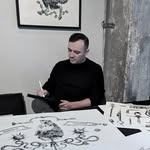
Andrej Zwetzig…
✦
…is a freelance artist and tattooer in Berlin and runs the artist collective “Wir sind Atelier” in Berlin-Hellersdorf. He is known for his detailed ink drawings and engraving style in his tattoos. We had the pleasure of meeting him at the Tattoo Convention 2025 in Berlin and were immediately charmed by his kind personality.
Find more from Andrej here:
Webseite
Instagram
(andrej.zwetzig)
✦
I have to agree with him — at least regarding the artist aspect. I am always amazed at how important the personality of the artist is to the viewer. Of course, not in all cases — there are plenty of people who see a beautiful image and want exactly that motif, regardless of whether it has been tattooed a thousand times or who tattoos it, as long as the price is right. In those cases, it doesn’t matter whether AI or human hands created the image.
But there is also a significant number of people who have “their” tattoo artist — just like they have their hairdresser. A friendly bond is formed, a relationship of trust as the basis for long and painful hours. I was quite surprised when a client told me she was planning a cover-up of her fresh tattoo. It was a beautiful tattoo, well executed and well placed — so what didn’t she like?
It was the experience during the session. The tattoo artist spoke in a foreign language with colleagues throughout the entire appointment and failed to build any real connection with the client. That negative experience alone was enough to make her want to cover up a good tattoo.
At the same time, people love their tattoos even when they are flawed or imperfect — because they value the connection with the tattoo artist, being close to a real human, sharing thoughts.
At the Tattoo Convention Berlin 2025, we also met Gino. He taught himself tattooing and art a few years ago and now runs his own studio in Argentina.
His talent extends beyond art into writing. In response to my questions, he wrote an entire essay — so beautiful that I have to include it as a quote:
“…I think that nowadays it’s impossible not to use AI, directly or indirectly. Even Siri already runs on AI. Taking a photo with a smartphone, or even the autofocus on a professional camera, are actions that already incorporate AI. Even the very text I’m writing right now will probably be corrected with the help of my BOT friend.
From my point of view, AI is just one more tool (or maybe thousands of tools), and we should
take advantage of it. The world we live in no longer allows us, unfortunately, to take the
amount of time we would like to create something.
I would love to lock myself in my workshop and build a unique piece over the course of months, spending hours on a tiny detail, polishing a hidden corner that no one will ever notice. But today that’s simply not
viable. Besides creating that piece, I also have to do the design, the budgeting, the material list, the development, the purchasing, the marketing, and even produce content to attract views on social media
So why not delegate some tasks to AI and save time? The time saved can be dedicated to creating.
I apply the same idea to art. No, I don’t want AI to grab my brushes and start painting. I’d rather have it help me solve certain situations. Most of my paintings and tattoos are based on reality. I use a lot of references: faces, animals, furniture, skulls. Sometimes I use photographs that I took myself; sometimes stock photos; and many other times I use AI to
create references, generate variations of my compositions, or improve an old photo that lacks definition. It’s incredible how we can change the angle of the light, or perhaps add a garment or a texture to part of the model.
The problem appears when too much help from AI starts to muddy our work. Those meaningless filigrees, those strange snakes, or those hands with extra fingers. It’s very obvious when an artist generates a design with AI and tattoos it exactly as it is. They look terrible, and they all start to look the same. I even see it in flyers or signage: everything looks monotonous, everything robotic.
Personally, when I see something without personality, I just scroll past it. I can’t pay attention to it or truly value it.
Clearly, the ease of creating things with AI is flooding us with mediocre work. But I don’t think
this will really affect us, because that drawing made with pencil and paper is still there. That
screen print with a slightly worn detail, or that drop of paint, gives it so much more value. I
don’t want a poster printed in industrial quantities; I want that small, dirty, wrinkled sketch
made by a human artist.
The path of the artist today is a difficult one. It’s not easy to make a living with everything that needs to be done. Today, if we want clients or reach, we depend heavily on social media, which unfortunately doesn’t reward effort, dedication, or talent. And if we can use AI to make the path a little easier, then why not?
Not many years ago, if we wanted an aerial shot, we needed a helicopter, a pilot, a cameraman, and an extremely expensive camera. Is it wrong that today we can replace that with a 100-dollar drone? No. We have to evolve, learn, and not stay stuck in the past.
AI is a tool, and as such it should help us, not do the work for us.
AI in the wrong hands won’t produce good results, just like an expensive new brush won’t make you paint any better.
I think there should be more accessible education about this new world that AI has created. Today it’s difficult to recognize an AI-generated video from a real one. This is also visible in the tattoo world. I won’t talk about the “fake artists” who post tattoos as if they were real, but rather about our clients, who with little knowledge about how skin, ink, and art actually work, can be misled by something AI shows them.
Today it’s very common for a client to inquire about a tattoo and send us their own
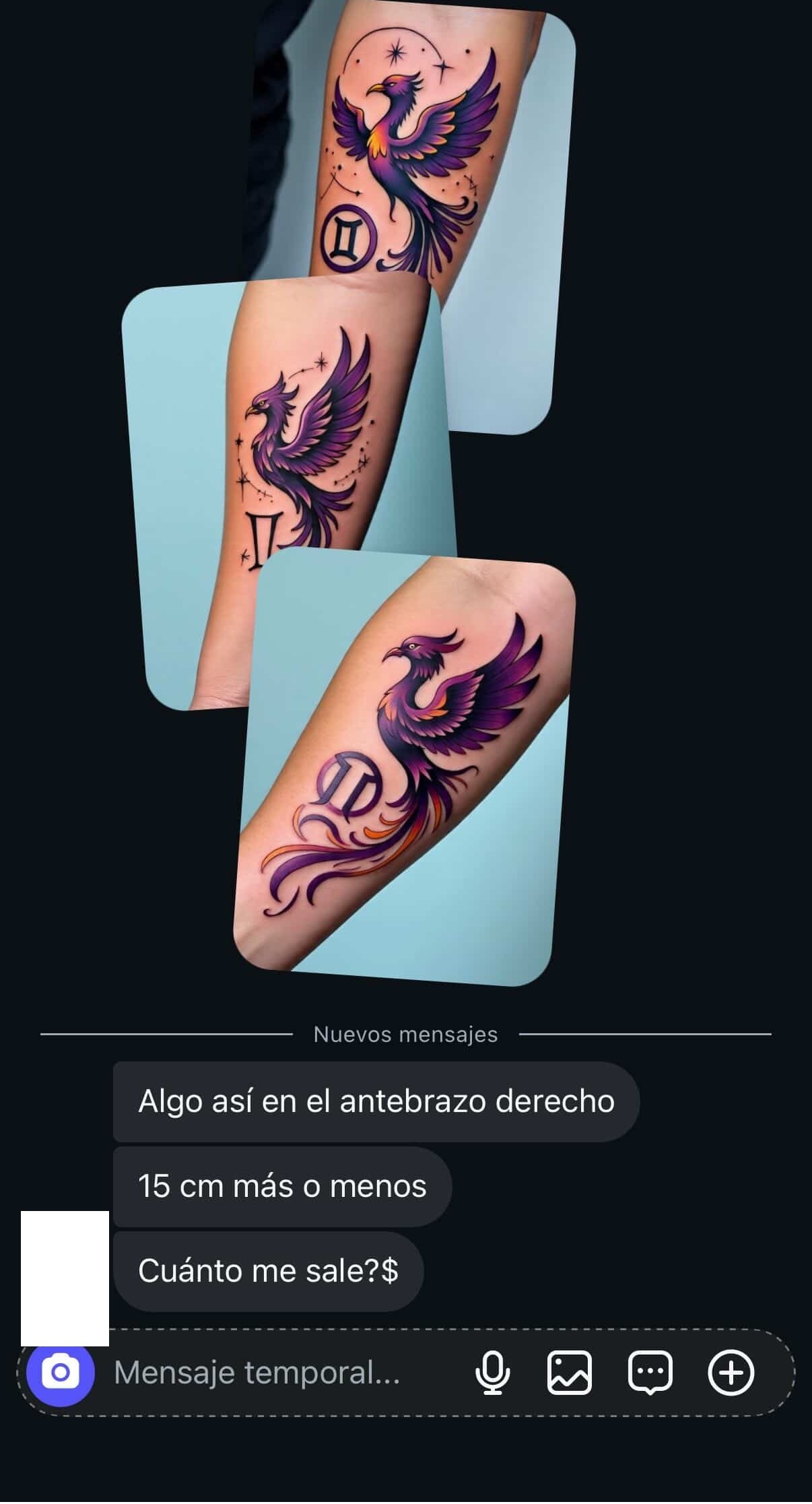
AI-generated design. I don’t judge them — it’s actually a good way for them to communicate what they have in mind. When this happens, I try to educate them and explain why certain things simply aren’t possible on skin. Even worse is when they want a cover-up and the AI just erases the old tattoo and places a new one on top without any real understanding of how tattooing works
I believe that all human creative processes are based on references, whether direct or indirect. The brain stores images, transforms them, analyzes them, remembers them, and from that we slowly build our style. (Something quite similar to what AI does.) We shouldn’t fight what’s coming. The sooner we understand that we’re going to live alongside this, the easier it will be. Let’s value the artist, the craftsperson, and individual style. Let’s buy more works made by humans and fewer subscriptions and licenses.
My morning coffee will always be served in
the ceramic cup made by an artist, and AI will never surpass that.“

Gino Scalone
✦
“I am Gino Scalone, a tattoo artist from Puerto Madryn, Argentina..
I started tattooing and painting at the end of 2021, thanks to an unexpected gift from my mother: a box of colored pencils. I had no experience or formal training, but that didn’t stop it from becoming my way of life within a few months. Before art, I worked in metal fabrication. I still have my workshop, but today it has become my personal cave where I can paint, weld, or create whatever comes to mind.
In 2024, I opened a private studio where I work alongside six other artists. Creating this space and sharing daily life with others has helped me grow in terms of techniques, styles, and ideas.
Currently, I focus on realistic designs and integrate elements of blackwork and illustration to improve the longevity of my tattoos. I am constantly searching for compositions that best create harmony between the tattoo and the natural movement of the body.
Fortunately, tattooing has allowed me to discover different countries, studios, styles, and incredible people. I hope my future in this industry continues in the same direction — always creating.
You can contact Gino here: aufnehmen:
Instagram (menhir.tattoostudio und ginostattoo)
✦
Thank you, Gino, for this incredible essay. Right after, he sent me a client request that used AI for their idea ——>
If you ever have the chance to meet Gino in Europe or Argentina, definitely get tattooed by him! His personality alone will win you over, and we hope to see him again soon.
Conclusion
Studios with AI generators are clearly filling a gap in the market. No long waiting times, designs are instantly available, and the tattoo artist becomes a service provider — much like a baker or carpenter. And there is nothing wrong with that. AI now supports tattoo artists who see themselves less as artists and more as craftsmen or workers. A phrase that went viral on this topic states:
“Those who work with their hands are workers — those who work with hands and mind are craftsmen — and those who work with hands, mind, and heart are artists.”
My own view of artists (and therefore myself) is not without criticism. Especially in Berlin, I often miss craftsmanship — the foundation of artistic work — which is painfully emphasized by an excess of “heart.” Most artists I spoke to are outraged by the use of AI. Both Andrej and Gino make it clear that they chose the artistic profession to create art themselves. AI would take over the very part that led them to tattooing in the first place.
And I feel the same — for me, tattooing is a way to build a career with my own illustrations. If it were only about quickly acquiring clients to make money, I would have stayed in my legal job or taken over my mother’s sausage stand. But that’s not what it’s about for most people. Placing your own creative work onto another human being is an incredible act — not only technically, but also deeply interpersonal.
I prefer to see it this way: tattoo artists who use AI-generated images serve an important clientele — one that artists with strong creative ambitions might not be happy working with anyway. A symbiosis from which both sides can benefit.